Civilian FPV & drone sports components
Technical SupportContact Sales Global · English

OEM and ODM · Electronics

Define a drone PCBA around its interfaces and tests.

A custom printed circuit board assembly begins with the complete system: the aircraft, power source, sensors, receiver, actuators, firmware and mechanical envelope. A board that fits on a drawing can still fail in the host aircraft if the interfaces, heat or test method are unclear.

Sichuan Yuanxin Supply Chain Technology Co., Ltd. offers a discussion route for drone PCBA design and manufacturing. Describe the intended function and current reference hardware, then confirm which design, sourcing, assembly, programming and testing activities are available for your project. No board-level performance or universal factory capability is asserted here without a specification.

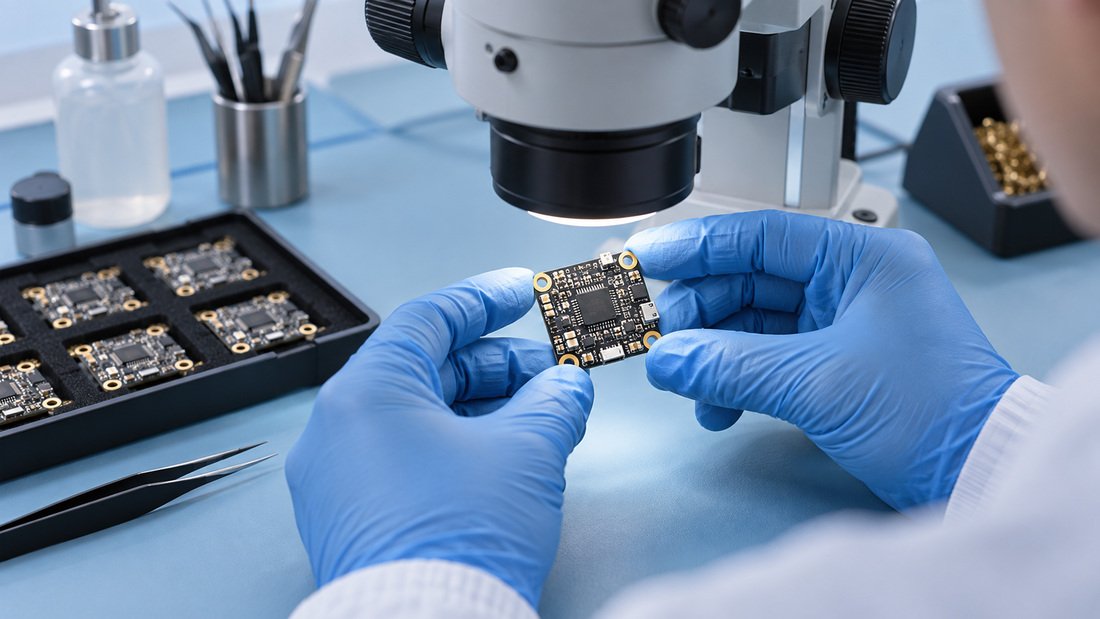
FPV circuit board shown for an electronics review
Verify the pictured board and process before identifying them with a specific project.

Start with the system

Which job must the board perform?

“Drone PCBA” can mean a flight controller, ESC, power distribution board, RF receiver, video accessory or another electronic assembly. Each needs a different schematic, layout, component choice, firmware and test strategy. The project brief should name the function before discussing the board dimensions or a preferred processor.

Draw a simple block diagram showing inputs, outputs, power rails and communication paths. List the mating connectors and their orientation. State voltage range, current, transient conditions, expected environmental exposure, maximum board outline, mounting holes and nearby components. If a particular enclosure or airframe already exists, provide a 3D model or measured clearance. A port that is electrically correct but inaccessible after assembly is still a design failure.

Describe firmware and configuration expectations. Will the board run existing firmware, a customized build or a new application? Who will configure it, load it in production and maintain it after shipment? What diagnostic information is needed when a user reports a failure? A board with a bootloader or USB connector may still require a defined programming fixture and version record to be produced consistently.

Identify the deployment environment and failure consequences. A classroom demonstrator, FPV racing component and civilian integration project may need different validation depth. If a buyer requires environmental, EMC, radio or safety testing, define the destination market and the exact standard or evidence needed. A design discussion should not imply that passing one bench test establishes legal approval for a complete aircraft.

Inputs for a quote

Provide more than a bare BOM

A BOM lists components but does not explain why a board was designed that way. If there is an existing design, send the schematic, board files, assembly drawing, known issues, firmware version and test procedure with appropriate permission. If the design is new, send requirements and a reference system. Mark components that are mandatory because of compatibility, certifications or existing tooling, and separate those from preferences that can be reviewed for availability or cost.

Set clear constraints on layer count or material only where there is a technical reason. A supplier can suggest a manufacturing route once mechanical limits, signals, thermal load and quantity are understood. Also identify parts with unusual availability, authorized sources, alternates and lifecycle concerns. An attractive prototype built from a hard-to-source component can be difficult to reproduce later.

Define how the board will be evaluated. State which signals will be measured, expected ranges, supply conditions, firmware image and pass criteria. Provide the mating harness and representative aircraft or fixture. A photograph of a powered LED is not proof that every input, output and protection function works. If you need a test report for each unit or lot, identify its required data fields and retention period in the project agreement.

Finally, specify commercial deliverables. Are you buying assembled boards, a full design package, programming, cable harnesses, an enclosure or a tested subassembly? Who owns design files, firmware changes, tooling and test fixtures? Which files must be handed over, in what formats and under which license? A quotation should make these distinctions clear so two proposals can be compared fairly.

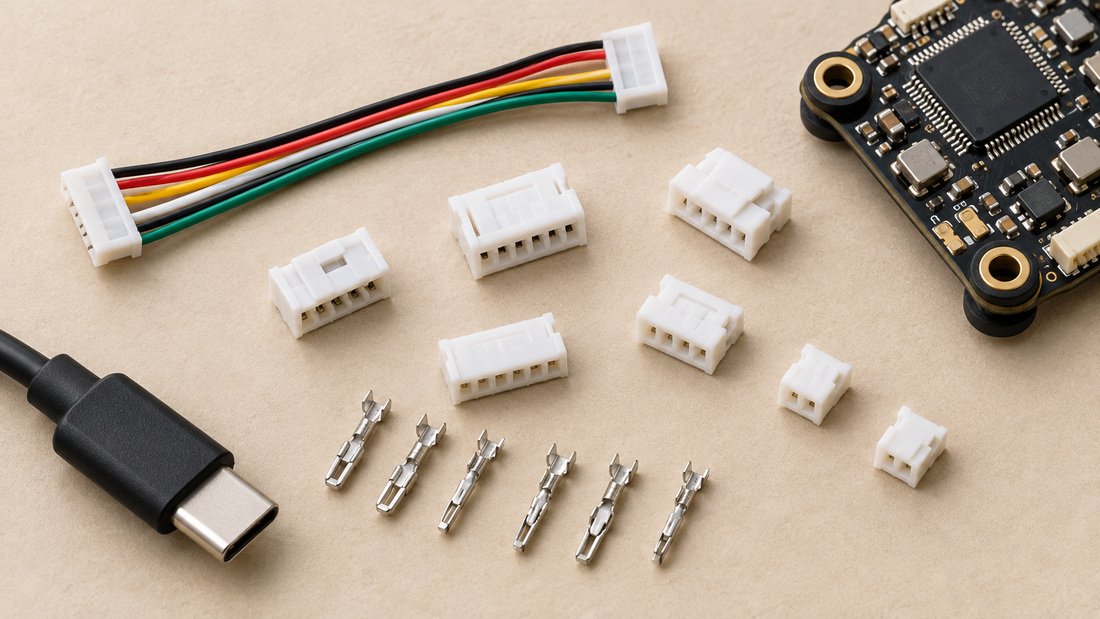
Connectors and wiring for an FPV electronics assembly
Use exact connector drawings for acceptance; this is contextual imagery.

A design path

Review the board through six gates

01

Requirements review

Agree on the block diagram, interfaces, mechanical envelope, power budget, software environment and test expectations. Resolve contradictions between the brief and existing hardware. Track assumptions that the buyer has not yet confirmed so they do not become accidental design inputs.

02

Component and architecture choice

Check availability, acceptable alternates, electrical margin and thermal implications. Decide which functions are integrated and which remain external. For radio related boards, antenna and layout choices can affect performance; an RF specialist may need to review the complete path.

03

Design review

Review schematic, layout, connector placement, mounting, test access and assembly notes. A manufacturer may propose changes for fabrication or assembly. Decide which changes affect performance or require buyer approval. Record revisions before ordering prototype material.

04

Prototype bring-up

Check power rails and protection before connecting expensive host equipment. Load the intended firmware, verify communications, measure critical signals and test in the representative build. Log faults and fixes, including the exact board revision and any hand modifications.

05

Production preparation

Finalize the fabrication package, component sources, programming procedure, test fixture and inspection criteria. Confirm whether a revised prototype or first article is needed after design changes. The approved sample should reflect the production configuration as closely as practical.

06

Build and support

Track the build revision and firmware, record agreed tests and label the boards so support can identify them. Define how a field issue will be reported and when a design change will be proposed. A repeat order should cite the released revision and approved substitutions.

Design for the actual use

Electrical, mechanical and production details

Power integrity: Identify normal and abnormal supply conditions, connector polarity, startup sequence and loads. A drone electrical system can experience transients and noise that are absent from a simple bench supply. Specify what protection is required and which failures must be detectable. Verify the design on the intended battery and related electronics, with measurements tied to the actual configuration.

Signal integrity and radio coexistence: Separate sensitive signals from power switching as the design permits. For a receiver or video accessory, consider antenna placement, cable routing, grounding and the nearby frame. A board layout alone cannot predict performance in every assembly. Define the RF measurements and system tests that matter, and avoid a range claim unsupported by controlled conditions.

Mechanical integration: Provide board outline, hole placement, maximum component height and cable bend constraints. Inspect the real installation for access to ports, cooling and vibration support. A board that meets nominal CAD dimensions may still foul a connector latch or protective enclosure. Prototype the stack with representative cables and fasteners.

Assembly and service: State whether connectors should be hand accessible, whether an antenna or harness is included and how the user will identify orientation. For a school fleet, replacement may be performed by trained staff, not an electronics engineer. For a distributor, a clear revision and label reduce incorrect returns. Design for test access where routine production checking is needed.

Documentation: Keep the pinout, operating range, board revision, firmware mapping, assembly notes and known limits together. Do not publish a borrowed schematic or generic datasheet under a new product name. When a board changes, update the documents and assess whether customer manuals or labels also need revision.

Validation and evidence

Agree on measurements before a board is called finished

Functional success should be defined by more than a brief flight or a power-on demonstration. A flight controller may need sensor checks, communications, output timing and failsafe behavior. An ESC may need load and thermal testing. A radio board may require link quality and frequency behavior evaluated with its antenna. A PCBA used in a classroom kit may need clear instructions and serviceable connectors as well as basic electronics function.

Set conditions for each test: power source, attached equipment, firmware, environment, sample quantity and acceptance threshold. Distinguish engineering characterization from routine production screening. The first can explore design margin; the second checks that assembled units meet a released criterion. If the customer needs reports or traceability, identify what will be recorded and supplied. A statement that an inspection exists without its method is too vague for a critical sourcing decision.

Market compliance deserves its own review. A board may be only a component in a larger product, but changes can still affect an end product's obligations. Battery safety information, radio rules, EMC and labeling vary by jurisdiction and product role. Ask which party is responsible for testing and documentation. Do not treat a prototype evaluation or unrelated certificate as approval of the final assembled aircraft.

When problems are found, keep a fault log tied to revision and test conditions. Resolve the issue, decide whether the fix affects other functions and rerun relevant checks. If a component is substituted between prototype and production, assess whether earlier test evidence still applies. A clear record prevents a later production team from assembling an obsolete design because it carries a familiar commercial name.

PCBA inquiry checklist

  1. Block diagram and required functions.
  2. Power, signals, connectors and mating equipment.
  3. Board outline, mounting and environment.
  4. Firmware, programming and diagnostic needs.
  5. Test criteria, files to deliver and target quantity.

A manufacturable handoff

Make the design understandable beyond its first engineer

A prototype can succeed because its designer remembers every workaround. Production cannot depend on private memory. Document polarity, orientation, programming connectors, calibration, labels, permitted rework and the difference between a good and bad test result. Mark components whose orientation is easy to confuse, and use assembly drawings to show which optional positions are populated for the ordered variant.

Review the design for assembly before buying volume components. Ask whether the chosen package is appropriate for the intended quantity, whether test points can be accessed in a fixture, whether connectors survive the planned assembly and maintenance process, and whether critical parts have a realistic supply path. A change that improves assembly yield can still affect the electrical behavior, so an approved engineering revision should precede its production use.

Define the outgoing kit precisely. Does a board ship with antenna, wire harness, screws, thermal material or firmware already installed? An integrator planning its own final assembly may want bare PCBAs with a test record. A school product may need protective housing and simple instructions. If accessories are excluded, say so on the quote and packing list. The board and its supporting parts should form one controlled order description.

Make fault handling practical. Keep a known good sample and a reproducible test method. Decide what data a service team needs when a unit fails in the field, and how a firmware or hardware fix will be released. If a board design is used across several products, record which end products use each revision. This mapping allows a targeted response instead of a vague warning to all customers.

A final review should ask whether the documents provided would allow another qualified team member to build, test and support the ordered board. If the answer depends on an undocumented conversation, the handoff is still incomplete. The scope of documentation and rights to it must be stated in the project agreement.

An electronics quotation should identify the exact stage at which a design becomes the production baseline. Before that point, component substitutions, test fixture changes and firmware adjustments may be expected parts of development. After release, a change requires assessment against the approved board and host system. The buyer should also know whether the supplier will retain fabrication files and test records, and how long those records are available. These details become significant when a board needs to be reproduced or investigated months after its first shipment.

Frequently asked questions

Drone PCBA design and manufacturing questions

What does a PCBA project include?

It depends on the agreement. Scope may include requirements review, schematic and layout, component sourcing, prototype assembly, firmware loading, test fixtures or production boards. Do not assume that a request for “PCBA manufacturing” includes design ownership, a complete aircraft integration or formal certification. List the expected deliverables and the responsible party for each stage.

Can I send only a BOM for a new design?

A BOM is useful but insufficient for a new board. Provide functions, interfaces, power, mechanics, firmware expectations and tests. If a reference design exists, share authorized drawings and known issues. Mark the parts that are fixed and the alternatives that can be considered. A clear requirements document prevents a supplier from quoting an assembly that does not meet the real application.

How do you check flight controller compatibility?

Compare pinout, voltage, protocol, firmware and mounting with the actual receiver, ESC, sensors and other equipment. A board may expose a compatible connector while its signal assignment differs. Use current drawings and a representative build, then test the intended behavior. The result applies to the checked configuration; other variants may require separate review.

What is the difference between a prototype and a production board?

A prototype can contain hand changes, limited testing or components selected for immediate availability. Production preparation requires a released design, approved sources, assembly instructions, programming and a repeatable test. If the prototype changes, determine whether a new approval or first article is needed. Label the two stages distinctly so a buyer does not mistake an engineering sample for final stock.

Who owns schematic and PCB files?

Ownership is a contractual matter. Define which files the buyer supplies, which are created in the project, whether third-party or open-source material is involved, and the rights to use, modify and transfer each item. Ask for the required file formats and version at handoff. Payment for assembled boards alone does not automatically grant every design file or license.

Can existing firmware be used on a custom board?

Possibly, if the hardware, licenses, pin mapping and required behavior are compatible. A familiar processor does not guarantee a firmware build will work without changes. Identify the intended firmware, configuration, bootloader and update path in the brief. Test the actual board revision with the complete system and record the approved software version for production.

How are component shortages addressed?

Agree on approved sources and alternatives before committing to production. If a critical device becomes unavailable, the supplier should propose a change with impact on electrical, mechanical, firmware and test requirements. The buyer decides whether to approve it and whether a new sample is required. An apparently equivalent component can still affect a sensitive drone system.

What testing should be requested?

Start with functions and risks: power, communications, outputs, sensors, radio behavior, thermal load and physical fit as relevant. Define setup, sample quantity and pass criteria. Distinguish one-time design characterization from every-unit production screening. Ask what test data will be supplied. No single checklist fits all PCBA functions.

Does a custom PCBA include regulatory approval?

No such blanket claim is made. A board's role, market and final integration determine applicable obligations. State the destination and required evidence early. If testing or certification is needed, identify which party will arrange it and whether it is included in the proposal. Do not infer final product approval from a board prototype or an unrelated model's report.

How should a board revision be identified?

Use a revision code in controlled drawings and production records and, where practical, on the assembly or label. Map firmware and test criteria to that revision. If a change affects compatibility, tell affected buyers and update documentation. A retail product name may remain the same while its technical revision changes, so support needs both identifiers.

What quantities can be prototyped or produced?

The supplied materials do not provide a universal prototype minimum, MOQ or capacity. Quantity depends on the board, components, assembly and test scope. Request a quote for sample and target production volumes. Ask which setup and fixture costs are separate, and which schedule assumptions depend on component lead times.

How do I report a fault in delivered PCBAs?

Provide the order reference, board revision, firmware, affected quantity, power source, connected equipment, symptoms, photos and steps to reproduce. Keep representative failed units and avoid uncontrolled rework until a review path is agreed. This information helps distinguish a manufacturing defect, design issue, damage or incompatibility in the host system.
Start the engineering review

Send the system, not just the board outline.

Include functions, interfaces, environment, firmware, target quantity and acceptance tests. We can then discuss a specific scope.