Civilian FPV & drone sports components
Technical SupportContact Sales Global · English

OEM and ODM · Bulk production

Scale an approved drone component with a controlled specification.

A production order should begin with a product that has already been evaluated, a documented revision and a clear way to decide whether delivered goods match the approved configuration. This page helps distributors, private label brands, schools and system integrators prepare those decisions for repeat supply.

The process below is a proposed sourcing framework. Confirm actual line capacity, inspection methods, traceability and lead time for the specific product in a written proposal. The company profile describes production activity but does not provide audited capacity or a universal quality certificate.

Drone-related production workline from the supplied image collection
Confirm the facility, activity and date before presenting this image as a current production process.

Before volume

What does “approved” mean for this product?

A prototype may be approved for basic function, for fit in one build, or for commercial production. Those are different decisions. Record which configuration was tested, by whom, under what conditions and against which acceptance criteria before ordering a larger batch.

For an ELRS receiver, the approval record may include board revision, firmware version, radio band, antenna and connector, output behavior and the host flight controller. For a propulsion combination, it may identify motor winding, ESC firmware, propeller, battery, test setup and thermal limits. For a drone soccer system, it may include aircraft model, protective assembly, controller, batteries, chargers and the school or club operating plan. A picture and a short SKU name do not capture all of those details.

Decide whether the approved sample represents an engineering prototype or a production-intent build. A hand modified board can demonstrate a feature without proving that an assembly line can repeat it. A printed packaging mockup can show layout without proving the final materials, labels and inserts. State which elements still need validation and make the release to production a deliberate decision rather than a silent assumption after the first sample works.

For a buyer, the approval record should be usable by procurement, engineering and incoming inspection. Give each revision an unambiguous identifier. Keep a controlled drawing or variant sheet, photographs of critical features, and a list of permitted substitutions. If a component becomes unavailable, decide who is authorized to approve an alternative and which tests are needed before it can enter the build.

Production brief

Information that determines a useful quotation

Provide the exact model and revision, target quantity by delivery, annual estimate if known, destination market, packaging requirement and desired schedule. Supply the approved sample or technical package and identify who owns it. If the project uses buyer supplied components, specify delivery responsibility, acceptable yield treatment and what should happen if incoming materials are defective. If a supplier will source the components, agree on the approved sources and rules for substitution.

List the tests or inspections that matter to the product. A visual check can catch missing labels or damaged connectors, but it cannot establish radio performance or correct firmware. Conversely, a passed functional test does not prove that the printed manual, carton contents and external label are correct. Define inspection at the points where an error can be found economically: incoming materials, assembly, programming, final functional check, packaging and buyer receipt as relevant.

Where the buyer plans to sell under its own brand, a production order should attach the final artwork and the exact model map. Confirm barcodes, languages, warnings, accessory list and any destination-specific product information. A packaging line must not pull an old insert simply because it looks similar. For a school fleet, label spares and chargers in a way that staff can match them to the approved aircraft; for a distributor, keep customer facing SKU and internal manufacturing revision related but distinguishable.

Ask what information will accompany each shipment. A packing list and invoice may be sufficient for some simple components. Other projects may need lot identifiers, a limited inspection record, a firmware manifest or battery shipping documents. Do not assume such documents exist; list the required records in the purchase agreement and verify which are available before the order is accepted.

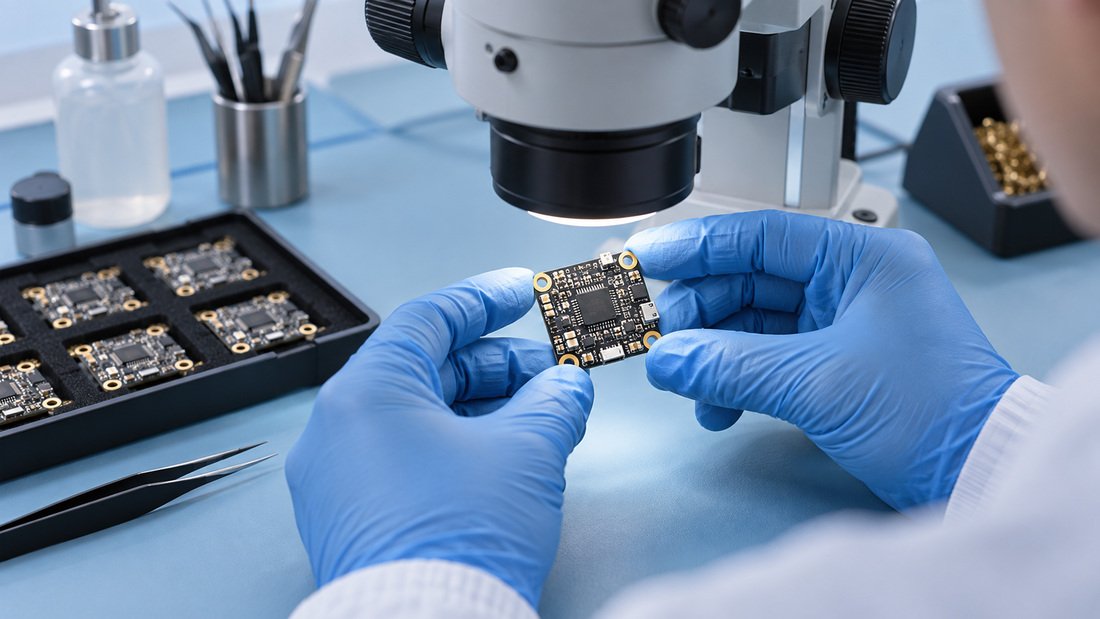
FPV electronics board inspection illustration
The inspection pictured does not establish a specific test protocol.

A controlled sequence

Six checkpoints from release to receipt

01

Configuration freeze

Agree on the released drawing, BOM, firmware, critical dimensions, label and packaging. Identify the approved reference sample and document any differences between that sample and production intent. Freeze does not mean future changes are impossible; it means changes must be visible and approved.

02

Supply review

Identify long lead parts, approved alternatives and the quantity needed for the run. A shortage can tempt an unreviewed replacement that alters performance. Ask who will flag a substitution, which evidence will be supplied, and whether a new sample or test is required.

03

First article

Compare an early production unit with the released requirements. Check the most consequential features first: board revision, connector, programming, physical fit, accessory count and label. Resolve discrepancies before they multiply across a batch. The exact first article method should be agreed for the item.

04

In-process control

Determine which checkpoints detect assembly errors. A PCB and a protected sports aircraft do not share one universal inspection plan. Define records proportionate to the risk and intended use. A test fixture, when needed, should be verified against a known good unit and maintained as the design changes.

05

Final release

Confirm that finished units, packaging and documents correspond to the accepted order. If a deviation is found, decide whether to rework, accept by written concession or hold shipment. Do not relabel a different variant as the approved SKU. Keep enough information to identify the affected units later.

06

Incoming review

The buyer checks an agreed sample of received goods, records transit damage and reports any mismatch promptly with order and lot details. A clear process helps separate shipping damage from assembly or integration issues. Feedback can then inform the next revision or reorder without rewriting history.

Change control

Protect repeatability when something changes

Hardware supply chains change. A connector source may change, firmware may receive a fix, a battery pack may use a different cell, or a packaging material may become unavailable. Some changes are nearly invisible to a casual inspection and still important to a customer. Define the trigger for notice: electrical or mechanical interface, RF path, firmware behavior, safety information, artwork, included accessories and anything else that affects the buyer's published claims.

For a simple change, a revised drawing and approval email may be enough. For a sensitive change, the buyer may require a new sample and test. A battery related change may affect transport documentation. A radio or antenna change may affect performance and market requirements. The supplier should not decide alone that a change is “equivalent” when the customer's complete system is unknown.

Use a version number that travels with the production record. Distinguish marketing name from technical revision. If the customer sells a part under a stable retail SKU, a manufacturing change can still be recorded internally and disclosed when required. Keep a mapping so support can determine which revision a customer holds. For school fleets, this can prevent a spare intended for a newer aircraft from being fitted to an older one without review.

A repeat order should cite the approved baseline, previous order and agreed changes. It should also revisit forecast and component availability. Treat an earlier successful shipment as evidence of one configuration, not a blanket guarantee that any future quantity can be supplied on the same schedule.

Production request checklist

  1. Approved sample and revision-controlled product specification.
  2. Quantity, delivery schedule, destination and packaging.
  3. Critical tests, inspection points and acceptance criteria.
  4. Approved substitutions and change notification process.
  5. Shipment records and after sale contact ownership.

Risk by product family

Inspect what can fail in the intended use

RF components: Check the requested frequency band, antenna and connector variant, firmware loading, output interface, labeling and a functional test appropriate to the design. Bench measurements should be tied to equipment and limits; a vague statement that the link works is not an acceptance criterion. The buyer also needs a representative system-level evaluation, because a receiver can pass a fixture test and still be incompatible with the selected transmitter or aircraft configuration.

FPV electronics: Check board revision, polarity, pinout, firmware, critical solder joints and mounting constraints. A visible board inspection is only part of quality control. Define what electrical function is checked and how a defect is recorded. If the design changes to another component, assess whether heat, voltage tolerance or output behavior is affected. Keep programming settings with the build record.

Propulsion: Link motor, ESC, propeller and battery specifications to the approved application. A motor's printed KV or an ESC's nominal current is not a complete system test. Define any balance, rotation, load or thermal checks that matter to the order. Ensure the kit contents and connectors match the installation plan. Do not claim a universal thrust value without the test configuration.

Drone soccer systems: Inspect protective shell fit, controls, battery and charger pairing, included accessories and safe replacement procedures. A school or club needs consistent equipment across a fleet and identifiable spares. Packaging should make it clear whether a kit includes one or multiple aircraft and which parts the user must supply. Record any permitted variant mix in the fleet proposal.

Private label packaging: Review the final print proof, barcode, model name, warnings, instructions and exact carton contents. Color matching alone is not enough. An attractive box with an incorrect battery or radio statement can create a customer problem even when the hardware itself works. Separate artwork approval from technical approval and make both prerequisites for release.

Commercial release

Keep the quotation aligned with the technical release

Bulk pricing makes sense only for a defined item. Ask whether the price includes programming, accessories, custom labels, retail packaging, inspection records, export packaging and freight. Identify currency, payment stages, trade term and responsibility for duties in the actual quotation. This page does not supply universal payment terms. A quote for a bare board cannot be compared directly with a quote for a packaged and tested retail kit.

Plan deliveries around the buyer's real demand. If a school must start classes on a particular date, account for sample approval, shipping, customs, instructor preparation and replacement stock. If a distributor is testing a new product line, it may be better to agree on an initial controlled order and a replenishment plan than to assume a large forecast is firm demand. Where split shipments are considered, define how each lot will be labeled and checked.

Resolve the treatment of excess and defective material before work begins. A custom color or branded carton may have limited alternative use. If the buyer supplies components, agree on ownership of leftovers and what happens if supplied parts fail incoming inspection. If the supplier sources materials, confirm whether price or schedule may change with an approved substitution. These are commercial choices tied to the same revision control as the engineering record.

Finally, set a communication rhythm appropriate to the project. A complex custom board may need a review at first article and again before shipment; a repeat standard item may need only confirmation of the revision and delivery date. The aim is to make the critical decision visible without creating ceremonial reports that neither side uses. Record exceptions and their approval in a place the buyer can retrieve when a support issue arises months later.

Frequently asked questions

Bulk production questions

What should be approved before bulk production starts?

Approve the exact hardware and firmware revision, representative sample, drawings, BOM, packaging, labels, critical tests and commercial order. Identify who can accept a deviation. If the sample differs from production intent, document that difference and decide whether a first article is needed. A purchase order should not rely only on a broad product family name.

Does a sample guarantee identical future batches?

A sample is a reference, not a guarantee without a controlled specification and change process. Components, firmware and suppliers can change. Define which attributes must remain fixed and how any proposed replacement is approved. Keep the approved sample and revision information available for incoming inspection and support.

Can I set my own inspection criteria?

Yes, propose criteria that reflect the product and application, then agree on feasibility, method, sample size and responsibility in writing. A visual, electrical or functional check addresses different risks. If you need a report or retained record, specify its content and delivery. Do not assume that a generic website quality statement supplies a complete acceptance plan.

What is a first article and when is it useful?

It is an early unit or small set from the intended production process reviewed against the released requirements. It can reveal a difference between an engineering prototype and repeat assembly, such as connector orientation, programming, labeling or packaging. The project should define who examines it and which results are needed before the rest of the run proceeds.

How are component substitutions handled?

Agree on an approved parts list and notification triggers. A replacement that seems electrically similar may affect RF behavior, thermal margin, fit, firmware or documentation. The supplier should identify the proposed change and supporting evidence; the buyer decides whether another sample or test is required. Do not treat a substitution as silent fulfillment of the original order.

Can you produce under a private label?

Private label production may be discussed once the exact hardware configuration and branding scope are defined. Provide artwork, packaging specifications, quantities and target market. Confirm rights to the brand and who approves customer facing claims. The quotation should state which labeling and packaging steps are included and whether a proof will be reviewed.

How is firmware version controlled?

Identify the firmware file or release, configuration parameters, programming method and verification check in the production record. A board with the right hardware can behave differently with another firmware version. Agree on how a later update is authorized and how support can identify the version installed in a delivered unit.

What production capacity or lead time is available?

No universal capacity or lead time is established by the supplied materials. The answer depends on the model, component supply, inspection scope, quantity and packaging. Request a quote with the approved revision, delivery plan and assumptions. Confirm whether a quoted schedule includes sample approval and any custom tooling or documentation work.

Will a production batch include certificates?

Only product specific and applicable documents should be requested or supplied. The availability of a certificate, SDS, UN 38.3 test summary or inspection report depends on the exact product and agreed scope. Identify the destination and required document before placing the order. Do not use a generic document from another variant as evidence for your batch.

How should a school order a fleet of drone soccer systems?

State the group size, number of simultaneous pilots, spare and charging plan, safe operating space and equipment configuration. Confirm whether each package includes aircraft, controller, battery, charger and replacement parts. Approve one representative system, then specify the same model and variant for the fleet unless a mixed configuration is deliberately planned.

What information should appear on a carton or unit label?

It depends on product, market and buyer requirements. At minimum, the label should identify the correct model or variant and be consistent with the invoice and packing list. A private label order may also require approved artwork, warnings, barcodes and lot information. Confirm any legally required markings with the responsible specialist before approving print.

How do I report a discrepancy after delivery?

Keep the goods and packaging, then send the order reference, model, revision or lot identifier, quantity affected, photographs and a clear description of the difference. Explain whether the issue appears on receipt or during integration. Follow the agreed inspection and remedy terms. A precise report helps distinguish transit damage, variant mismatch and functional failure.

Release with clarity

Bring the approved configuration to the discussion.

Send the product specification, reference sample status, quantity and acceptance questions. We can then discuss a realistic production scope.